

3 coworking desks found in Canary Wharf







Coworking Desks in Canary Wharf: your questions answered
Less than you probably expect: £450 per desk per month for a private office, against a London median of £530. That is more than a quarter below the city-wide figure, on live listings as at November 2026. The towers have a reputation for expense that the flexible market does not bear out, largely because the floor plates are enormous and the buildings are modern, so the cost per desk of running them is low. Everything is inside the rate: rates, service charge, utilities, internet, furniture, cleaning, security and reception.
The usual short list, plus one that is specific to the estate. Meeting rooms beyond an allowance and printing above fair use are normal. The local one is parking: unlike most of London there is a great deal of it here, in the towers and the shopping centre beneath them, and it is almost always charged separately rather than bundled. Rates vary widely between buildings, so if several people drive, price it before you compare offices. Otherwise the specification is high by London standards, with proper air conditioning, full-height glazing and lifts that were designed for the building rather than retro-fitted.
Quickly, and more predictably than in most of London. The estate is built from large modern buildings with professional operators in them, so viewings are easy to arrange and the paperwork is standard: a licence and a deposit of one to two months, then a week or two to move. With 4,166 desks across 119 listings, availability in the common sizes is reliable. Larger requirements are also easier to place here than anywhere else in this tier, because whole floors genuinely come free rather than being carved out of a converted townhouse.
Strikingly so. A desk here is £450 against £779 at Liverpool Street and £911 at Bank, for a journey of about fifteen minutes between them on the Elizabeth line or the Jubilee. That is less than half the price for a better standard of building. The trade is the setting rather than the specification: Canary Wharf is a planned estate that empties in the evening, and for some teams the absence of streets, pubs and passing trade is the reason not to come. On cost per desk it is difficult to argue with.
Every single listing. Canary Wharf is the only area in this tier where one station is nearest to 100% of the offices we list, which is a function of how the estate was built: towers arranged around a transport interchange, with almost nothing more than ten minutes' walk from it. The station carries the Jubilee line, the DLR and, at the separate Elizabeth line entrance, direct services to Liverpool Street, Farringdon, Bond Street, Paddington and Heathrow. That combination reaches most of London without a change and has improved considerably since the Elizabeth line opened. If your team is scattered across the south east, it is one of the easiest places in London to get everyone to.
Thirteen, which is the second fewest in this tier and worth understanding before you start. Canary Wharf's buildings are large and expensive to take on, so the operators here are the ones with the balance sheet to do it: national and international serviced brands, plus space run by the estate itself. You will not find the single-building independents that give Shoreditch or Clerkenwell their range. The upside is consistency, since standards are high and predictable across the estate. The downside is that if one operator's style does not suit you, there are fewer alternatives than the listing count suggests.
683 people in one office is the ceiling here, by a wide margin the largest in this tier and more than three times what Holborn or Old Street can offer. That is the estate's real distinction. If you need to seat two hundred people together, there are only a handful of places in London that can genuinely do it and this is the most reliable of them. The range runs all the way down to two-person offices, so smaller teams are not shut out, but the economics tilt towards scale: the cost per desk falls faster here as the office grows than it does in converted stock elsewhere.
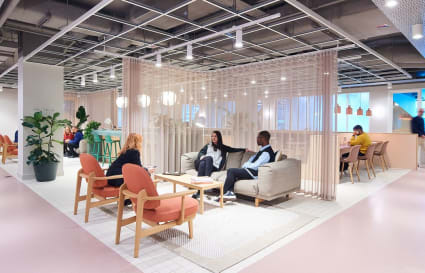
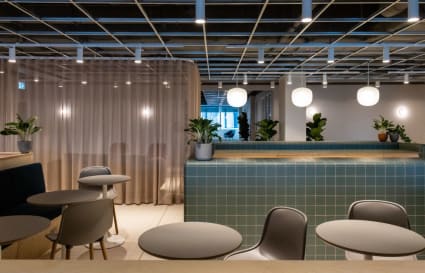
Higher than the rate implies, and that is the strongest practical argument for the estate. A markedly greater share of listings here carry full air conditioning, on-site showers, secure cycle storage and gym access than the London average, because the buildings were purpose-built as offices within the last thirty years rather than converted from something else. Lifts, floor loading, natural light and cooling are all designed in. If your team cycles or runs, the end-of-trip provision here is among the best in London. The thing you give up is character: these are corporate interiors, and no amount of fit-out disguises the fact.
Yes, and it is one of the few parts of London where driving in is genuinely practical. The estate sits outside the Congestion Charge zone, so there is no daily charge, and there is a large amount of underground parking beneath the towers and the shopping centre. The Ultra Low Emission Zone still applies, so an older vehicle is charged regardless. Spaces are usually rented monthly and priced separately from the office, and the cost is not trivial, so confirm it early if several people drive. Approach roads from the A13 and the Blackwall Tunnel are busy at peak times but the last mile is straightforward.
If the appeal is price and space, Aldgate at £550 per desk is the closest City-side equivalent, and Stratford is cheaper again with similar modern stock. If it is the Elizabeth line, Farringdon and Paddington sit on the same route. If it is the large floor plates, Moorgate is the only area in this tier that comes close. And if the estate's after-hours emptiness is what puts you off, London Bridge offers modern buildings and mainline rail in a place that stays open in the evening.

